Why Indiana's Public Broadcasting Cuts Threaten Democracy



Written by Daniel John Dunevant on May 3, 2025, 6:24 am
Why Defund Local Journalism and Culture?
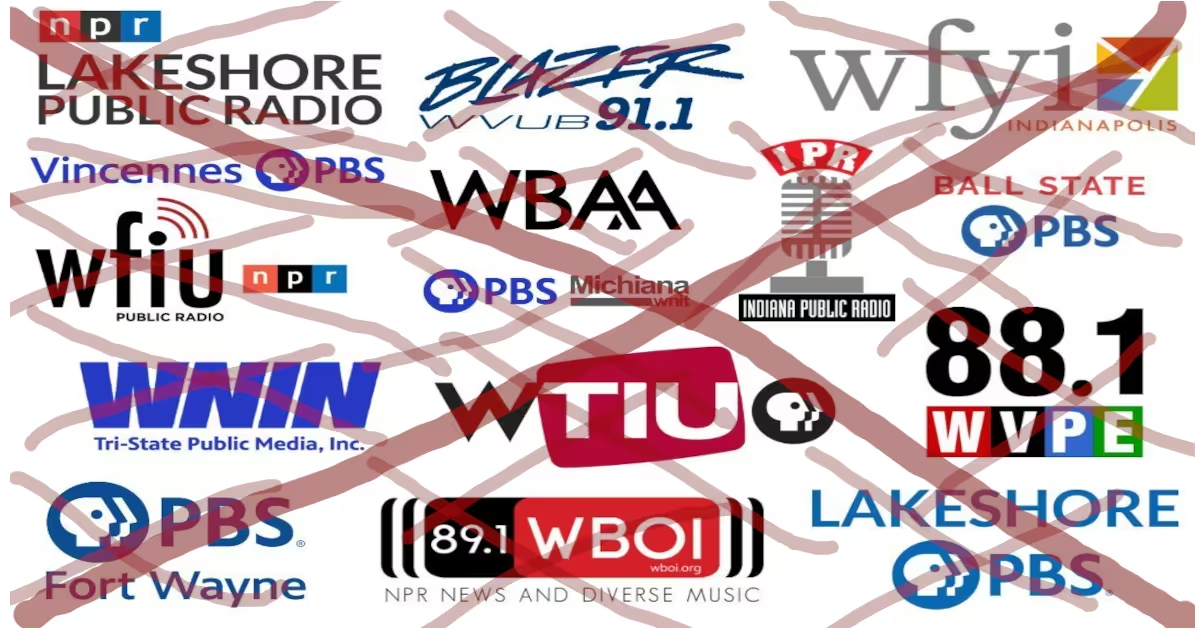
Why would the Indiana government choose to remove funding from those who provide public services like local news, events, and cultural programming? Is this simply a reflection of the broader government-cutting trend spearheaded by movements like DOGE, or is it something deeper?
At its core, this move seems rooted in a fundamental misunderstanding of the government's role. Government exists not to mimic the free market, but to fill the gaps it leaves behind—especially where profit incentives fail to meet public needs.
The Free Market Doesn't Serve All
The so-called "free market" is far from free—constrained by capital access and systemic barriers that favor those who already hold power. Many vital services simply aren't profitable. Public broadcasting is one of them.
Consider your own experience tuning into the radio. How many stations provide meaningful coverage of local issues, civic engagement, or international news? The majority loop advertisements and generic music. For many, public radio is a rare source of substance—an informative lifeline during long drives or daily commutes.
Public Investment Drives Innovation
Much of what we consider indispensable today—such as the internet—was created through government-funded research. Unlike private entities focused on short-term profits, public institutions can take long-term risks and fund critical initiatives in technology, medicine, and education.
Public funding has also driven cancer research and supported university-led studies that benefit society broadly. Defunding these initiatives doesn't make government leaner; it makes society weaker.
Libertarianism vs. A Free Society
Free market fundamentalism, or modern libertarianism, often undermines the very freedom it claims to uphold. In practice, it diminishes protections for the most vulnerable while reinforcing the influence of entrenched power.
The government's role is to check that imbalance—to defend the poor against the powerful, and to ensure opportunity isn’t reserved only for the privileged.
What DEI Actually Promotes
Diversity, Equity, and Inclusion (DEI) initiatives are frequently misunderstood. Contrary to popular critiques, they aim to *increase* meritocracy by expanding access and opportunity.
Consider this excerpt from Harvard Law’s analysis of Trump’s rollback of DEI:
“Significantly for federal contractors, the January 21 DEI Order revokes Executive Order 11246, which required federal contractors to take affirmative action to ensure that applicants are employed, and that employees are treated during employment, without regard to their race, color, religion, sex, sexual orientation, gender identity, or national origin.”
Compassion, Not Condemnation
Those who support these regressive policies aren’t inherently malicious. Many are shaped by upbringing, socioeconomic position, and limited exposure to diverse perspectives. What they need isn't ridicule, but compassion—a steadfast commitment to dialogue and understanding.
However, compassion should not mean silence. These policies do real harm—widening inequality and consolidating control among elites. We must resist with clarity and conscience, even while recognizing the humanity of those who disagree.
Constitutional Ironies in Indiana
Recently, Indiana passed a resolution to formally submit to Jesus Christ as the "ruler of the state." This blending of church and state is not only unconstitutional but also deeply ironic. The teachings of Jesus often criticized religious leaders for hypocrisy and the elevation of outward piety over true compassion and justice.
As Axios reports, this is part of a broader alignment with a political agenda that seeks to enshrine specific religious and ideological views in law—something that directly contradicts both Indiana’s and America’s founding documents.
Public Broadcasting as a Safeguard
Defunding public broadcasting isn’t about cost-saving—it’s about control. Public media offers an independent voice, free from the influence of advertisers and political donors. It informs the public, holds power accountable, and gives a platform to underrepresented voices.
Removing this voice weakens democracy and leaves citizens more vulnerable to misinformation, political manipulation, and cultural stagnation.
Conclusion: Defending What Serves Us All
Indiana’s move to cut public broadcasting and embrace ideological control is a warning signal. We must reaffirm the role of government as a servant of all people—not just the wealthy, not just the devout, and not just the powerful. Democracy depends on an informed public, and public media plays a central role in that mission.
Programming Articles
- The Hidden Influence: Why AI Training Data Should Concern Us
- Open Code Valparaiso 3-8-2025 Meeting
- Setting Up Form Validation in JavaScript: Functions and Best Practices
- Understanding Obtrusive vs Unobtrusive Javascript and Best Practices
- Understanding the MVC Design Pattern in Web Development
Philosophy Articles
- The Word of the Year: Hyper-Localization
- Understanding Perspective and Knowledge: The Role of Epistemology in Truth and Belief
- The Limits of Perspective: Understanding, Blind Spots, and Growth
Political Articles
- A Call for Justice And the Future
- We are Spartacus We are Bob
- Million Bob March
- Valparaiso City Council Split on AHRC Reforms: Republicans vs. Democrats
- Valpo Oltoff Housing Development
- Is Free Speech Worth the Cost (Yes, of course it is)
- Why Indiana's Public Broadcasting Cuts Threaten Democracy
- Civil Rights to DEI
- The Supreme Court’s Political Shift: Presidential Power & the Chevron Decision